Amateur ExtraE9B01
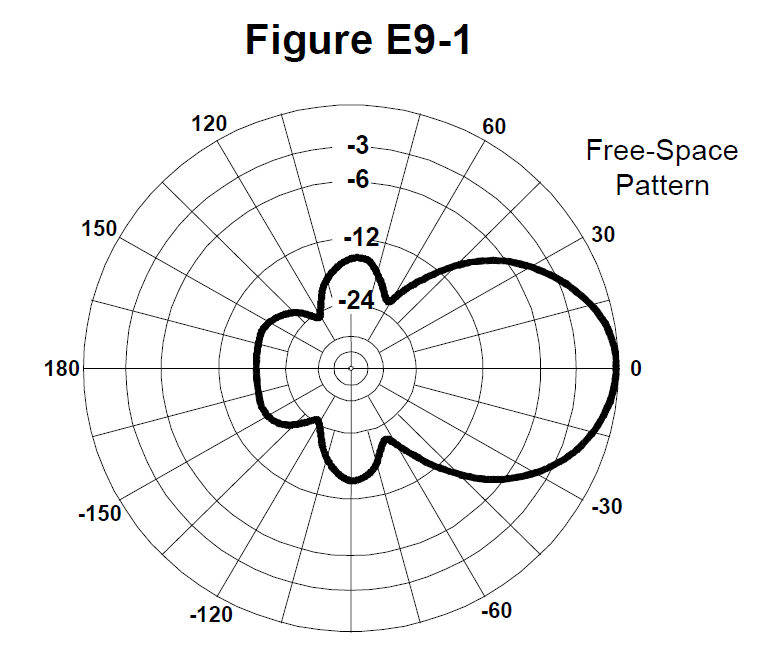
What is the 3 dB beamwidth of the antenna radiation pattern shown in Figure E9-1?
B
Answer
Antennas and transmission lines
Type
A
75 degrees
B
50 degrees
C
25 degrees
D
30 degrees
Answer Notes
The 3 dB beamwidth of an antenna is defined as the total angular distance between the points on either side of the main lobe where the signal strength drops by 3 dB. A 3 dB drop represents the half-power points, which is the standard boundary used to define the effective width of a radiated beam.
In Figure E9-1, the maximum forward gain is positioned at the 0-degree mark on the outer edge of the graph (0 dB). Following the shape of the main lobe outwards from the center axis, the signal strength drops by 3 dB (touching the -3 dB ring) at approximately the 25-degree and 335-degree (-25 degree) marks.
To find the total beamwidth, calculate the angular spread between these two half-power points. Adding the 25 degrees on the left side to the 25 degrees on the right side results in a total beamwidth of 50 degrees.
Previous · E9A12
How much gain does an antenna have compared to a half-wavelength dipole if it has 6 dB gain over an isotropic radiator?
Next · E9B02
What is the front-to-back ratio of the antenna radiation pattern shown in Figure E9-1?